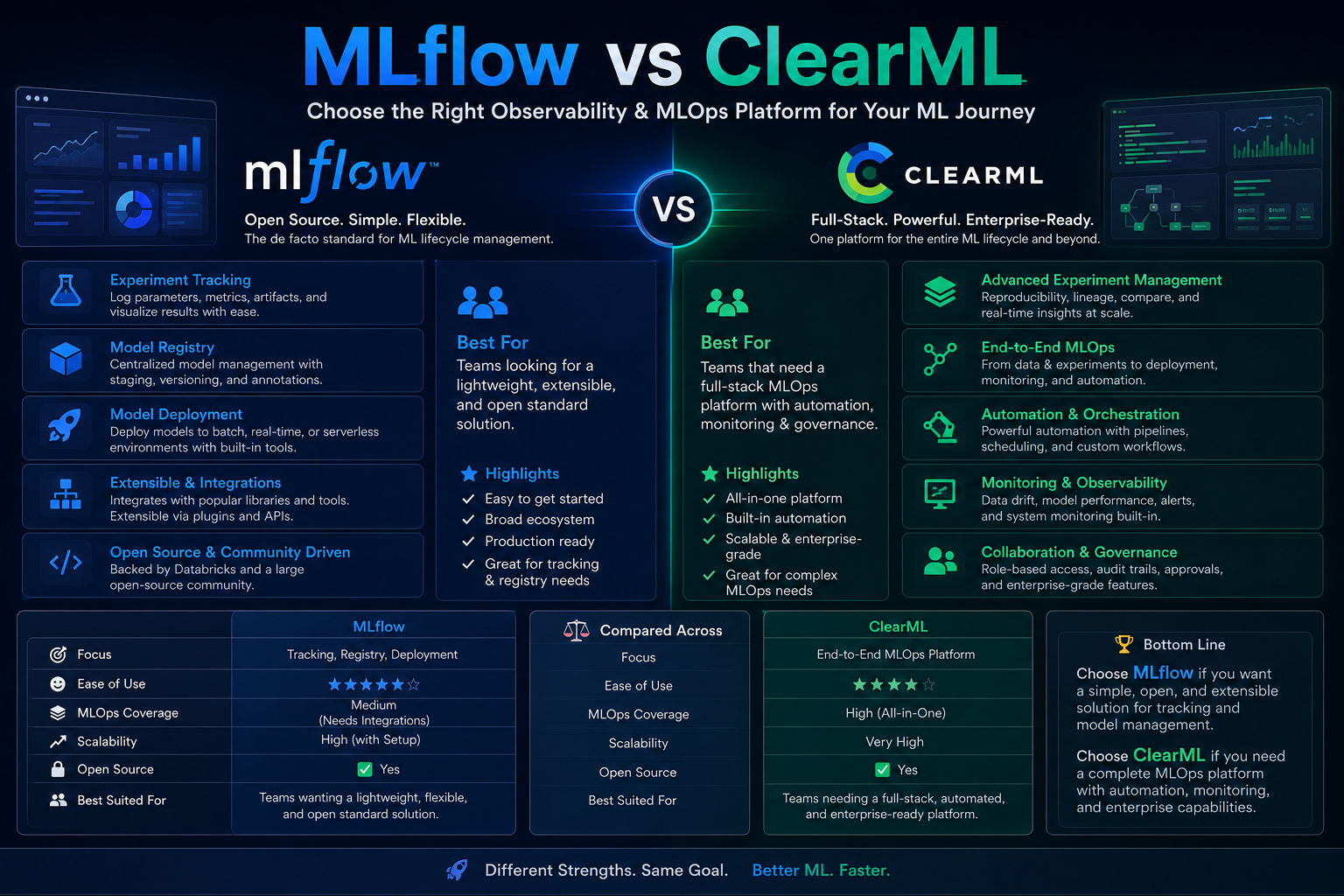
MLflow vs ClearML: Which Open Source MLOps Tool Actually Wins? (2026)
MLflow vs ClearML verdict: MLflow wins for experiment tracking and self-hosting ease (one command). ClearML wins for pipeline orchestration and team features.
of ML projects never reach production
faster iteration with proper tracking
per user/month for premium tools
1. Why This MLflow vs ClearML Comparison Matters in 2026
The MLOps tool landscape in 2026 is polarized. Paid tools like Weights & Biases charge $50+/user/month. Open source tools are free but require you to know what you actually need.
MLflow vs ClearML is a crucial decision for any ML team. MLflow and ClearML are the two most serious free options. But they attract completely different teams for completely different reasons.
💡 Context: MLflow is backed by Databricks (now a $43B company). ClearML (formerly Allegro Trains) is used by 150,000+ engineers.
According to official MLflow documentation, the tracking server can be deployed with a single command.
2. What Is MLflow?
💰 Free (Open Source)
MLflow is the de facto standard for experiment tracking. Created by Databricks in 2018, it now lives under the Linux Foundation.
- ✅ MLflow Tracking — log parameters, metrics, artifacts
- ✅ MLflow Projects — package code for reproducible runs
- ✅ MLflow Models — standardized model packaging
- ✅ MLflow Registry — centralized model version management
Best for: Teams that just need experiment tracking, multi-language support (Python, R, Java).
|
1 2 3 4 5 6 7 |
import mlflow mlflow.set_experiment("my-model") with mlflow.start_run(): mlflow.log_param("learning_rate", 0.01) mlflow.log_metric("accuracy", 0.94) |
In the MLflow vs ClearML debate, MLflow takes the lead for teams who want simplicity above all else.
3. What Is ClearML?
💰 Free / $15/user
ClearML is an end-to-end MLOps platform covering experiment tracking, pipeline automation, data versioning, and model serving.
- ✅ Experiment Tracking — auto-logging with zero code changes
- ✅ Pipeline Automation — turn any Python function into a pipeline step
- ✅ Data Versioning — dataset lineage tied to experiments
- ✅ Remote Execution — ClearML Agents run on GPU clusters
Best for: Python teams wanting a complete open source MLOps platform.
|
1 2 3 4 5 |
from clearml import Task task = Task.init(project_name="my-project", task_name="experiment-1") # Auto-logs: hyperparameters, metrics, GPU/CPU usage, git diff, console output |
When evaluating MLflow vs ClearML, ClearML stands out for teams needing a complete platform rather than just tracking.
4. Head-to-Head Feature Comparison
Looking at this MLflow vs ClearML feature comparison, the pattern becomes clear: MLflow is a focused tool, ClearML is a full platform.
5. Pros & Cons — The Honest Version
✅ MLflow Does Well
- ✓ Up and running in under 10 minutes
- ✓ Python, R, Java support
- ✓ Native Databricks integration
- ✓ Massive community
❌ MLflow Falls Short
- ✗ No pipeline orchestration
- ✗ No data versioning
- ✗ Basic UI
- ✗ No hyperparameter tuning
✅ ClearML Does Well
- ✓ Auto-logs everything
- ✓ Full platform (pipelines + data + serving)
- ✓ Free self-hosted
- ✓ Built-in hyperparameter optimization
❌ ClearML Falls Short
- ✗ Harder self-hosted setup
- ✗ Python only
- ✗ Smaller community
- ✗ Complex architecture
6. Which One Should You Choose?
Choose MLflow if…
- You just need experiment tracking
- Your team uses R or Java
- You want the fastest setup
- You prefer explicit logging
Choose ClearML if…
- You want one tool for everything
- You need pipeline orchestration
- Data versioning is non-negotiable
- Your team is Python-only
🧠 The Mastermind Answer: The MLflow vs ClearML decision comes down to minimalism (MLflow) vs comprehensiveness (ClearML). Many serious teams use both.
7. The Verdict: MLflow vs ClearML
📖 External resources: Official MLflow Documentation • ClearML Official Site • MLflow GitHub • ClearML GitHub
📚 Related Reading: ClearML Review • MLflow vs W&B • 7 Best W&B Alternatives • Kubeflow vs Airflow
#ClearML
#MLOps
#ExperimentTracking
#OpenSource
8. Frequently Asked Questions
▼
▼
▼
▼
▼